
By Mateusz Perkowski | Feb. 5, 2026 | Capital Press
Fewer restrictions would be imposed on voluntary groundwater pumping reductions under a bill meant to ease the economic impact on irrigators from new regulations in the Harney basin.
Late last year, Oregon water regulators decided to regulate the basinowing them to halt groundwater withdrawals to achieve stable aquifer levels over roughly 30 years.
Under that plan, irrigators in the region can avoid mandatory pumping curtailments by entering into voluntary agreements with the Oregon Water Resources Department (OWRD) to decrease their withdrawals.
However, critics of the new regulatory regime argue that OWRD’s requirements for such voluntary agreements are overly restrictive and will dissuade irrigators from participating.
More Flexibility
To provide irrigators with more flexibility, Rep. Mark Owens, R-Crane, has introduced House Bill 4049, which would expand the types of voluntary agreements allowed under the rules.
For example, Owens said the OWRD’s existing guidance requires each voluntary agreement to encompass a substantial amount of groundwater in each of the basin’s seven sub-areas, which isn’t equitable because it effectively favors large landowners over smaller ones.
“I don’t think that’s correct. You’re going to have community members who are going to want to start and choose voluntary agreements instead of wasting money on litigation,” he said.
Critics of the OWRD’s existing guidance also say it sets overly strict requirements for reducing groundwater declines under voluntary agreements, discouraging plans that would be less economically disruptive.
House Bill 4049 would not set a minimum threshold for participation and would allow voluntary agreements that result in “reasonably stable” groundwater levels, rather than requiring declines to stop entirely, according to supporters.
The goal of voluntary agreements should be to encourage irrigators to begin reducing groundwater withdrawals as soon as possible, rather than relying on OWRD enforcement to curtail pumping, said Elizabeth Howard, an attorney who supports HB 4049.
However, the agency’s existing guidance doesn’t provide such incentives, she said. “People on the ground are very reluctant and very concerned about doing voluntary agreements.”
The bill would help remedy a “deep frustration” in the Harney basin community, which felt that “local input was not being valued” by OWRD in establishing the critical groundwater area, said Sabrina Maki, a supporter of HB 4049.
“Voluntary agreements are a last, best option to rebuild trust and work collaboratively with the commission to protect groundwater while preserving agriculture in Harney County,” she said.
WaterWatch Objects
However, the WaterWatch of Oregon nonprofit argues the bill goes further than provide flexibility for voluntary agreements, which is already permissible under existing regulations.
“To be clear, this bill would undermine the rules, it would undermine the science, and it would allow voluntary agreements to proceed that don’t meet existing law,” said Lisa Brown an attorney for the environmental group.
According to WaterWatch, the bill could effectively subject groundwater users who don’t participate in voluntary agreements to stricter pumping curtailments.
The group also claims the proposal would give irrigators too much leeway in deciding the amount and timing of pumping reductions.
The existing rules provide a “very generous 30-year timeline for achieving stability,” but under HB 4049, the schedule for reaching goals would be rendered “indeterminate,” if they’re ever reached at all, according to WaterWatch.
The bill affects a highly complex “intersection” of law and science and such changes should not be rushed during this year’s monthlong short legislative session, Brown said.
“If there’s a desire to rewrite existing voluntary agreement law, we believe it should be done in a long session in a manner that’s inclusive to ensure that we do a rewrite that complies with existing law, protects all of the interests, and doesn’t undermine the progress that we’ve already had in the Harney basin,” she said.
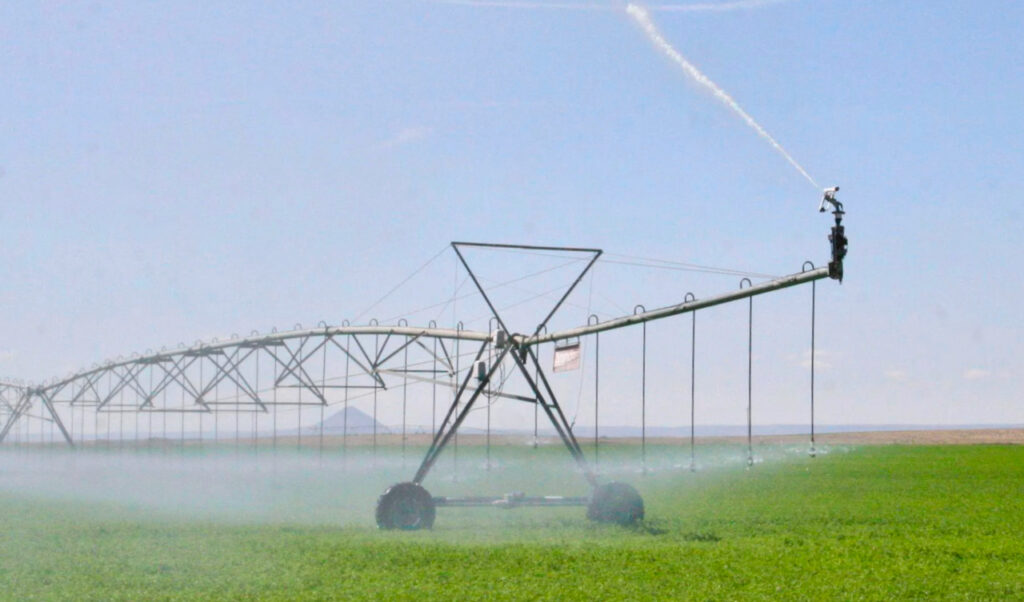
This article originally appeared in the Feb. 5, 2026, issue of the Capital Press. Irrigation pivot photo courtesy of Mateusz Perkowski / Capital Press.