
By Zach Urness | Nov. 6, 2024 | Salem Statesman Journal
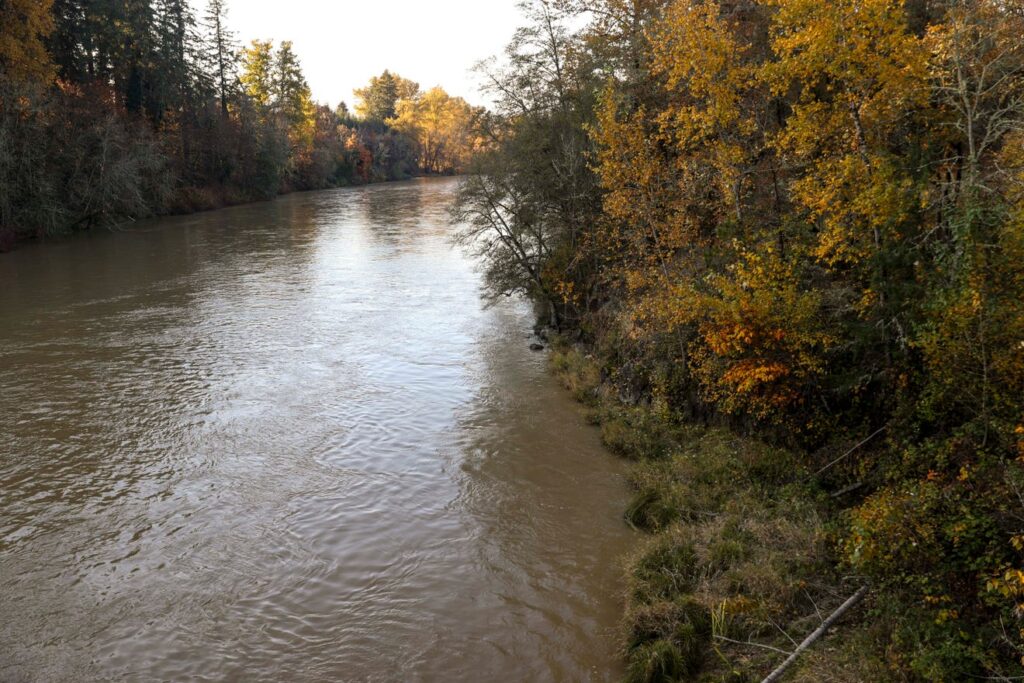
The city of Lebanon on Monday requested an “immediate halt” to the drawdown of Green Peter Reservoir amid increasingly turbid water in the South Santiam River that is challenging the city’s drinking water systems.
The city made the request as the amount of sediment in Foster Reservoir and the South Santiam River increased, leading to concerns over degradation to the city’s drinking water filters.
The city asked the U.S. Army Corps of Engineers and Oregon Health Authority (OHA) to stop the drawdown, which has been ordered by a federal court to allow endangered juvenile spring chinook salmon to pass downstream through Green Peter Dam and reach the ocean.
On Tuesday afternoon, the Oregon Health Authority denied the request, saying current conditions “do not meet the halt criteria” outlined in a federal plan approved earlier this year.
The city stressed it would continue to make water safe to drink for its population of roughly 30,000 but noted the continued muddy water in the Santiam, due to the drawdown, was pushing the city’s drinking water filters beyond their recommended use.
“They’re putting us in a situation where our water source is so turbid that they’re asking us to go against the specifications for our (water filtration) membranes for an extended period,” Lebanon city manager Ron Whitlatch said. “We can meet clean water demand to a certain point, but beyond that — where we are now — if something goes wrong that’s on them. They’re putting our drinking water source at risk and costing us a lot of money. This is about supporting our infrastructure and ratepayers.”
Despite Increased “Turbidity,” OHA Denies Request
Turbidity, meaning sediment in the river, ranged from 60 to 93 formazin nephelometric units on Tuesday at a variety of locations. In comparison, Whitlatch said the river in previous years would occasionally spike to 50 FNUs after a heavy rain, but that it was temporary.
The drawdowns, which can cause an extended period of muddy water, puts stress on the city’s water treatment filters, Whitlatch said.
However, OHA determined the city had not met the criteria, laid out in a court modification earlier this year, to stop the drawdown.
“Based on recent raw water turbidity readings that you provided … your system’s capability to treat such levels to meet the finished water … appear adequate and do not pose any current public health risk,” OHA said in a letter. OHA added that it expected turbidity to decrease in coming days.
Corps officials did not directly comment on the request. They did say Sweet Home and Albany, who could also request a halt to the drawdown, have not done so. Corps officials added that turbidity this year was significantly less acute than a year ago, when the river water was above 100 NTUs for more than a month and spiked as high as 800 NTUs for extended periods.
Earlier this year, the cities of Lebanon and Sweet Home filed a lawsuit for $37 million against the Corps for damage to their water systems they say came as a result of the drawdowns.
The cost for a new “pre-treatment” facility and membranes to purify the water would amount to about $26 million in Lebanon, while Sweet Home is saying it would cost $11 million.
“The bottom line is our ratepayers shouldn’t have to feel the brunt of the cost from a plan we had no involvement in,” Whitlatch said previously. “It’s just a very frustrating situation.”
What is the controversy over Green Peter Reservoir drawdowns?
The drawdowns, in which the reservoir is almost completely emptied, was first ordered by U.S. District Court Judge Marco Hernandez in 2021 following a lawsuit by three environmental groups.
The goal was to allow endangered salmon smolts to migrate through Green Peter dam in a plan aimed at saving the species from extinction. But during the first drawdown, in autumn of 2023, mass amounts of sediment were pushed downstream, fouling the drinking water of Sweet Home and Lebanon.
The cities and regional politicians asked for a pause in the drawdowns, but in September Hernandez approved a plan for the practice to move forward under a slightly different timetable and with the ability to cities to ask the Corps to halt the drawdowns.
The Green Peter drawdown is currently underway but still needs to drop another 40 feet or so to reach its target elevation, where it will stay for 30 days to allow juvenile fish to pass through dam’s bottom.
Environmental Groups Defend Reservoir Drawdowns
Environmental groups have consistently defended the drawdowns as necessary to save spring chinook salmon from going extinct.
The Corps takes salmon migrating from the ocean above Green Peter dam in trucks and releases them into spawning habitat in Quartzville Creek and the Middle Santiam River. The juvenile fish born must migrate downstream and the reservoir drawdowns are the quickest and easiest way to help them reach the ocean, advocates say.
“We have to keep drawing down these reservoirs as long as the cities can still deliver clean drinking water with the tools and technologies available,” said Jennifer Fairbrother of the Native Fish Society. “The way things are going, we could lose local salmon and steelhead runs in the next 15 years if we don’t do this. These drawdowns are the best shot we have to help those fish bounce back. We’ve seen it work before at other reservoirs, so we know it can make a real difference.”
U.S. Army Corps fish biologist Greg Taylor said the number of wild spring chinook smolts that migrated downstream through Green Peter was “very small” last year, but noted it was just the first year of the drawdowns and more time was needed “before any conclusions can be reached about how well it’s working.”
This article originally appeared in the Salem Statesman Journal on Nov. 6, 2024.