
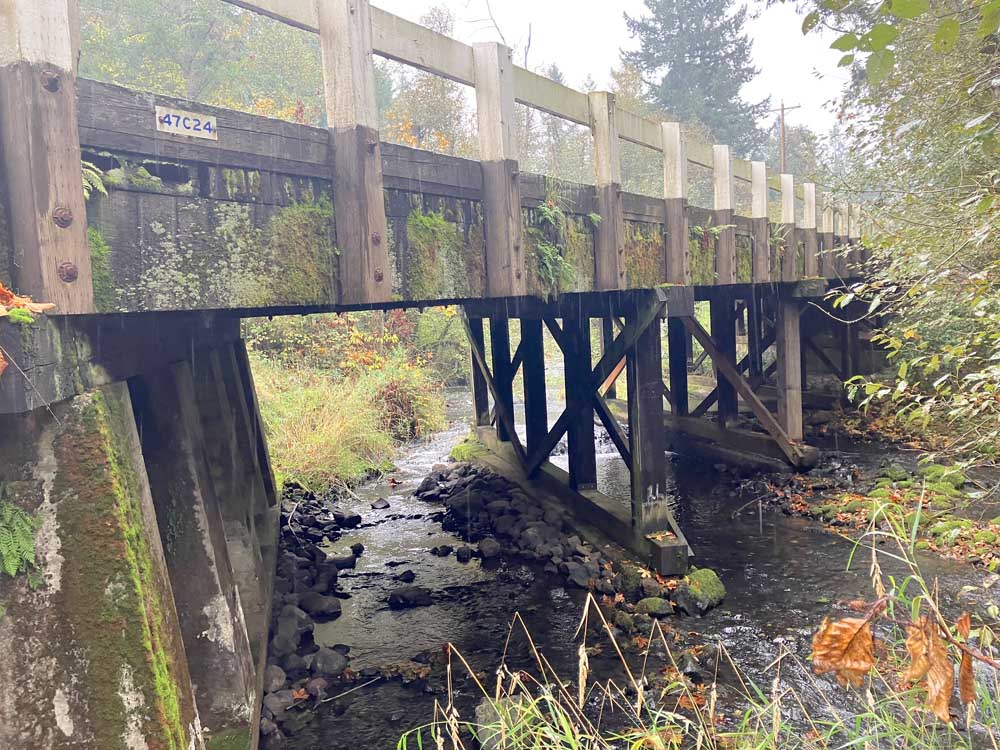
By Mateusz Perkowski | April 16, 2026 | Capital Press
A proposal to build a new 12,000 acre-foot irrigation reservoir in Oregon’s Willamette Valley has again failed to pass muster with state water regulators.
The East Valley Water District had urged the Oregon Water Resources Commission to authorize the project, which would inundate nearly 400 acres on Drift Creek near Silverton.
The commission previously rejected the proposal in 2019, but the Oregon Supreme Court ordered the matter to be re-evaluated last year.
According to that ruling, the commission didn’t fully examine all seven public interest factors required by law in originally denying the reservoir application.
On reconsideration, the commission has determined that although six of the public interest factors work in the project’s favor, that’s outweighed by its adverse impact on water rights.
The proposed reservoir was initially denied because the commission said it would subvert the purpose of a senior instream water right, which is meant to protect cutthroat trout, by inundating three miles of Drift Creek.
That factor again proved decision in the commission’s most recent order, which said that frustrating the instream water right’s purpose would be a “detriment to two separate and significant public interests — the protection of senior water rights in the system of prior appropriation and the establishment and protection of rights whose purpose benefits the public as a whole.”
The East Valley Water District has 60 days from April 7th, when it was formally served with the commission’s order, to decide whether to again challenge the denial in court, said Kirk Maag, the district’s attorney.
“East Valley is very disappointed in the Commission’s decision to deny East Valley’s application for a water storage permit,” Maag said in an email. “That denial elevates instream water rights above all others, undermines economic development, tolerates poor habitat conditions on Drift Creek, and impedes Oregon’s prosperity roadmap.”
Maag said the commission had tried “showing the work” behind the original denial but its recent order still does “not reflect the careful consideration of the public interest factors required by statute and the Oregon Supreme Court’s remand order.”
During oral arguments before the commission earlier this year, Maag argued that approving the reservoir was the only acceptable decision if all seven public interest factors were truly considered.
Apart from the impact on the East Valley Water District, a denial would have repercussions for other storage projects at a time when surface water and groundwater resources had grown scarce, he said.
“New storage is one of the few options available to provide an alternative source of water to meet existing and growing demands,” Maag said.
Overriding the other public interest factors based on the in-stream water right “can’t be squared with applicable law,” particularly since the commission could impose a condition requiring the reservoir to function in a way that protects cutthroat trout, he said.
The project had other conditions that are aimed at preserving winter steelhead and would help fish by allowing cool water to be released into Drift Creek during summer months, Maag said. “The only way to advance the public interest is to improve the application.”
Farmers whose land would be submerged by the reservoir — who are not members of the irrigation district — were joined in opposing the project by WaterWatch of Oregon, an environmental nonprofit.
Brian Posewitz, an attorney for WaterWatch, told the commission that damming the stream runs counter to the state’s “integrated water resource strategy” and would harm economic development by eliminating farmland.
“In short, we believe putting a dam and reservoir on Drift Creek would just cause too much damage to fish, wildlife and water quality in Drift Creek at a time the state is spending an estimated $10 million a year to take dams out of streams,” Posewitz said.
This article originally appeared in the April 16, 2026, issue of the Capital Press, which also owns the banner photo credit of Drift Creek.