
This article appears in the summer 2026 issue of WaterWatch of Oregon’s Instream newsletter.
Data centers present new challenges for Oregon’s waters, often in places where rivers, aquifers, imperiled species — and communities — have nothing left to give.
Data centers use water in several ways. Some use water to cool clusters of servers housed in a building. Some data centers do not use water-based cooling technology, but all data centers use water indirectly because these facilities consume massive amounts of electricity. Creating electricity is one of the most water-intensive industries in the United States. Unfortunately, little data exists on this indirect water use by data centers, but it is known to be many times the direct onsite use of these facilities. Not surprisingly, data centers have been less than transparent on their water consumption.
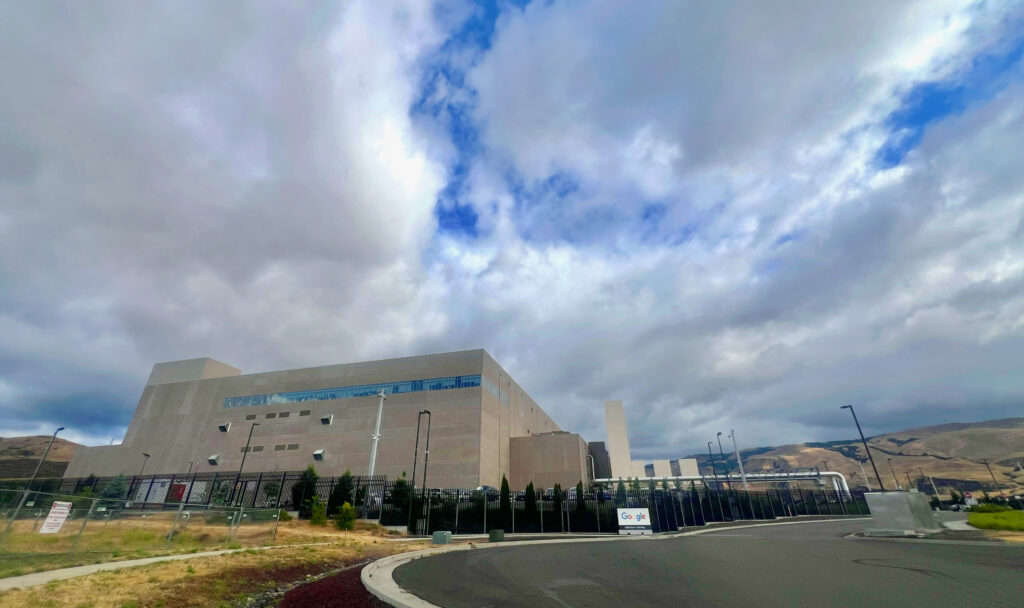
Depending on how one defines a data center, Oregon currently has between 120 and 135 data centers in operation, with several more in the planning stages. Some of these planned data centers, if built, would be the largest such facilities in the world. Many are being located in water-scarce areas where surface waters are already over-appropriated in the dry season, or in areas of concern due to declines in aquifer levels. Some, like Google’s large facility in The Dalles or Amazon’s operation in the Umatilla Basin, are in areas with existing restrictions on additional groundwater use.
Some data centers, or the municipal entities that supply water to them, must mitigate some portion of their water use. Unfortunately, mitigation requirements are not consistent across Oregon, or in many places do not exist at all. Oregon also lacks a strong understanding of the thermal impacts to waters caused by the discharge of spent cooling water, and the state has done a generally poor job of addressing temperature pollution in Oregon’s rivers, especially with our changing climate.
Many data centers are exploiting Oregon’s water laws by using municipal water rights that have never been fully developed. To accommodate future growth, Oregon law allows municipal water developers to hold onto water rights with early priority dates but not develop that water until much later. Unfortunately, in the intervening years and decades, Oregon has failed to account for this undeveloped water and permitted other uses from the same source waters, often overallocating streams and aquifers. Now, with additional water demand from data centers, Oregon allows municipalities to develop these senior water rights often at the expense of those with junior priority dates, including instream water rights, and the needs of fish and wildlife. To no one’s surprise, this can wholly upset the apple cart for fish and wildlife, and for other users.
In fact, this scenario is playing out now in The Dalles with Google’s data center water demand. The Dalles has chosen to expand its use of an old water right from the Dog River in the Hood River watershed. For more than a century, this water right was never more than about half developed. Now, a junior instream water right on the Dog that supports multiple runs of Endangered Species Act fish will likely be significantly impacted due to this development. While the pipeline and Crow Creek reservoir for The Dalles’ water supply are on U.S. Forest Service land, the Forest Service has refused to consider the impacts of additional water use by the city, in part because the Crow Creek Reservoir lacked the capacity to receive additional water.
Enter HR 655, Representative Cliff Bentz’s bill passed by the House of Representatives in December 2025. If passed by the Senate, HR 655 would transfer federal public land at the reservoir to The Dalles and allow the city to expand its reservoir, thereby enabling The Dalles to fully develop its Dog River water right, primarily for Google’s data centers. You can object to HR 655 by contacting Senators Ron Wyden and Jeff Merkley via the QR code provided below, and view our coalition letter opposing HR 655.
You can also submit comments about Oregon’s waters and data centers to the governor’s Data Center Advisory Committee and see WaterWatch’s comments to the committee.
Banner photo of The Dalles Google data center and Instream cover design by Monet Hampson.
 Get your edition of this framed Willamette River print, they won’t last long! Dan Coe prints are available by: