
This article originally appeared in the autumn 2025 issue of WaterWatch of Oregon’s Instream newsletter.
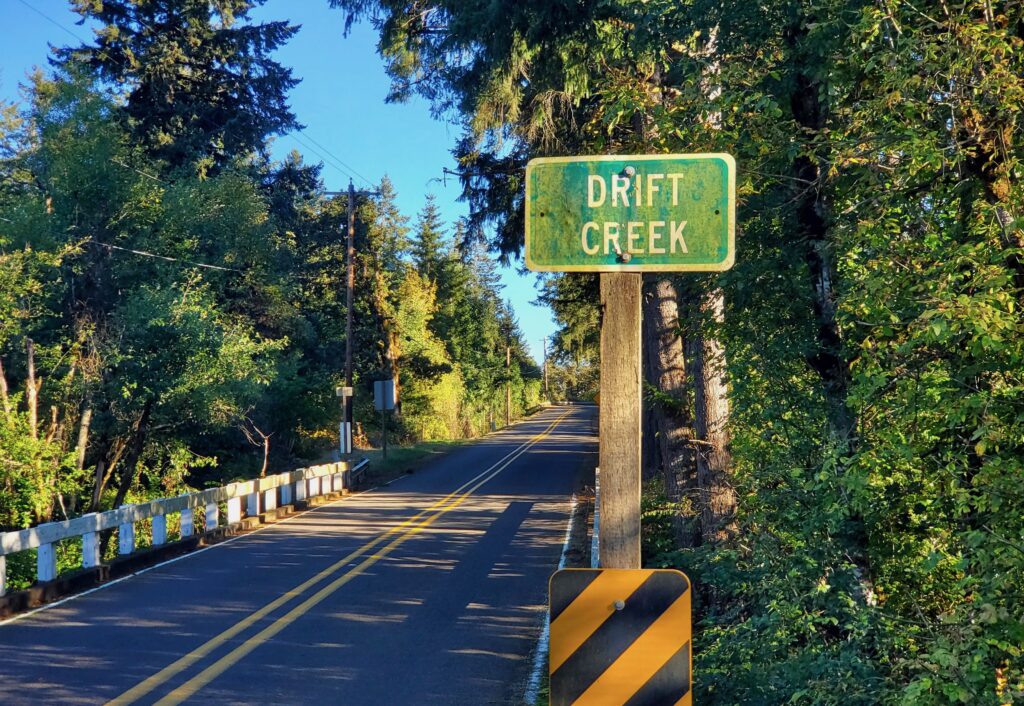
A proposal to build a new dam and reservoir on Drift Creek, a tributary to the Pudding River in Marion County, is heading back to the Oregon Water Resources Commission — but only after setting an important precedent for protection of instream water rights at the Oregon Supreme Court. The case is another example of how key water policy wins often come after years of hard work by WaterWatch and our supporters.
In February 2013 the East Valley Water District, a public irrigation district, applied to the Oregon Water Resources Department for a permit to build a 70-foot dam and 350-acre reservoir across the channel of Drift Creek, which originates near Silver Falls State Park and flows about 11 miles to the Pudding River south of Silverton. The district claimed the water was needed as a backup supply for farmers in the Mt. Angel area, who currently rely on a combination of groundwater rights and rights to divert water from various streams in the area.
WaterWatch opposed the proposal primarily due to the impact it would have on fish habitat. While Drift Creek has been somewhat degraded by agricultural, residential, and forestry uses, several groups are working to restore the stream, which continues to provide important habitat for cutthroat trout, coho salmon, and Pacific lamprey, and for steelhead and Chinook salmon listed as threatened under the federal Endangered Species Act. An instream water right issued in 1996 protects flows throughout the stream specifically for the benefit of cutthroat trout.
The district’s proposed dam and reservoir, which would be about six miles upstream from the mouth of Drift Creek, would harm fish using the stream by inundating three miles of the stream under a reservoir pool, by preventing fish migration between the lower and upper portions of the stream (because there would be no fish passage at the dam), by making the water too warm and too low in oxygen in both the reservoir and points downstream, and by impairing seasonally varying flows important to creating and sustaining fish habitat. The reservoir would also flood a valley used by elk and other wildlife.
In addition, the district’s proposal was opposed by local farmers who would be displaced by the reservoir. They don’t want to sell, but the district plans to take their land using its governmental power of eminent domain.
WaterWatch and the farmers opposing the project also pointed out that members of the irrigation district already have water rights for their land and, if they need more water, could find less destructive ways to get it, including contracts for water stored in existing Willamette Basin reservoirs that could be delivered down the river and piped to the district.
The controversial proposal’s journey through the Oregon water rights litigation process began in July 2014, when the Water Resources Department proposed to issue the requested storage permit over the objections of WaterWatch and the local farmers. In September of that year, WaterWatch and the farmers filed legal challenges to that decision, called “protests,” which triggered a referral, after a two-year administrative delay, to Oregon’s Office of Administrative Hearings for a “contested case” hearing, a process like a court case but presided over by an administrative law judge.
After two years of exchanging documents and other information (“discovery”) and arguments on various pretrial issues, the contested case culminated in a two-week trial-like hearing in June of 2018. Several months later, the administrative law judge issued a proposed order to approve the proposal with additional conditions. All parties filed “exceptions” to the proposed order, but the Water Resources Department essentially affirmed its initial decision to approve the proposal. In October of 2019, WaterWatch and the local farmers filed exceptions to that decision with the Oregon Water Resources Commission, which was the final decision maker at the agency level.
The commission recognized the harm the dam and reservoir would do to cutthroat trout using the stream. Since the instream water right was intended to serve that use, the commission reasoned the dam and reservoir would conflict with the instream water right, contrary to a directive in Oregon law to consider “vested and inchoate rights to the waters of this state or to the use of the waters of this state, and the means necessary to protect such rights.” The commission therefore decided the proposal would “impair or be detrimental to the public interest” and denied the district”s application.
The irrigation district appealed the commission’s decision to the Oregon Court of Appeals. WaterWatch filed several detailed briefs in response to the appeal and motions related to the appeal, and argued alongside the commission in support of the commission’s order in November 2022. In November 2023, the Court of Appeals ruled in favor of the commission and WaterWatch, upholding the commission’s decision in its entirety. With the help of several water user groups appearing as “friends of the court,” the district then convinced the Oregon Supreme Court to take up the case, even though the court can choose not to hear a case, and in fact hears only a small fraction of those presented to it. The district, the commission, and WaterWatch all filed further briefs with the Supreme Court and were joined by multiple nonparties appearing as “friends of the court.” The Oregon Water Utility Council, the League of Oregon Cities, and Special Districts Association of Oregon filed a brief in support of the district, as did the Oregon Association of Nurseries.
The Confederated Tribes of the Warm Springs Reservation of Oregon, the Confederated Tribes and Bands of the Yakama Nation, the Confederated Tribes of the Umatilla Indian Reservation, and the Nez Perce Tribe also filed a brief in support of WaterWatch, as did the conservation groups Columbia Riverkeeper, Oregon Wild, and the Northwest Environmental Defense Center.
The Supreme Court issued its decision Aug. 8th. While the court sent the case back to the Water Resources Commission to expressly consider statutory public interest factors in addition to the impacts on existing water rights, which we at WaterWatch believe the commission already did implicitly, the court affirmed the analysis of the commission and Court of Appeals with respect to instream water rights. Rejecting the district’s arguments, the Supreme Court agreed that a water right, including an instream water right, protects the use it is intended to serve, not just a specific quantity of water at a specific place on a stream.
WaterWatch expects the Supreme Court’s decision to give robust protection to instream water rights throughout the state by protecting the uses served by those rights — fish, wildlife, recreation and water quality — as well as specific quantities of water in the streams. As such, the Drift Creek case is another example of how years of hard work can pay off with far-reaching precedents in favor of protecting Oregon’s rivers, streams, and groundwater.
Banner photo by Tommy Hough.
 Get your edition of this framed Willamette River print, they won’t last long! Dan Coe prints are available by: