
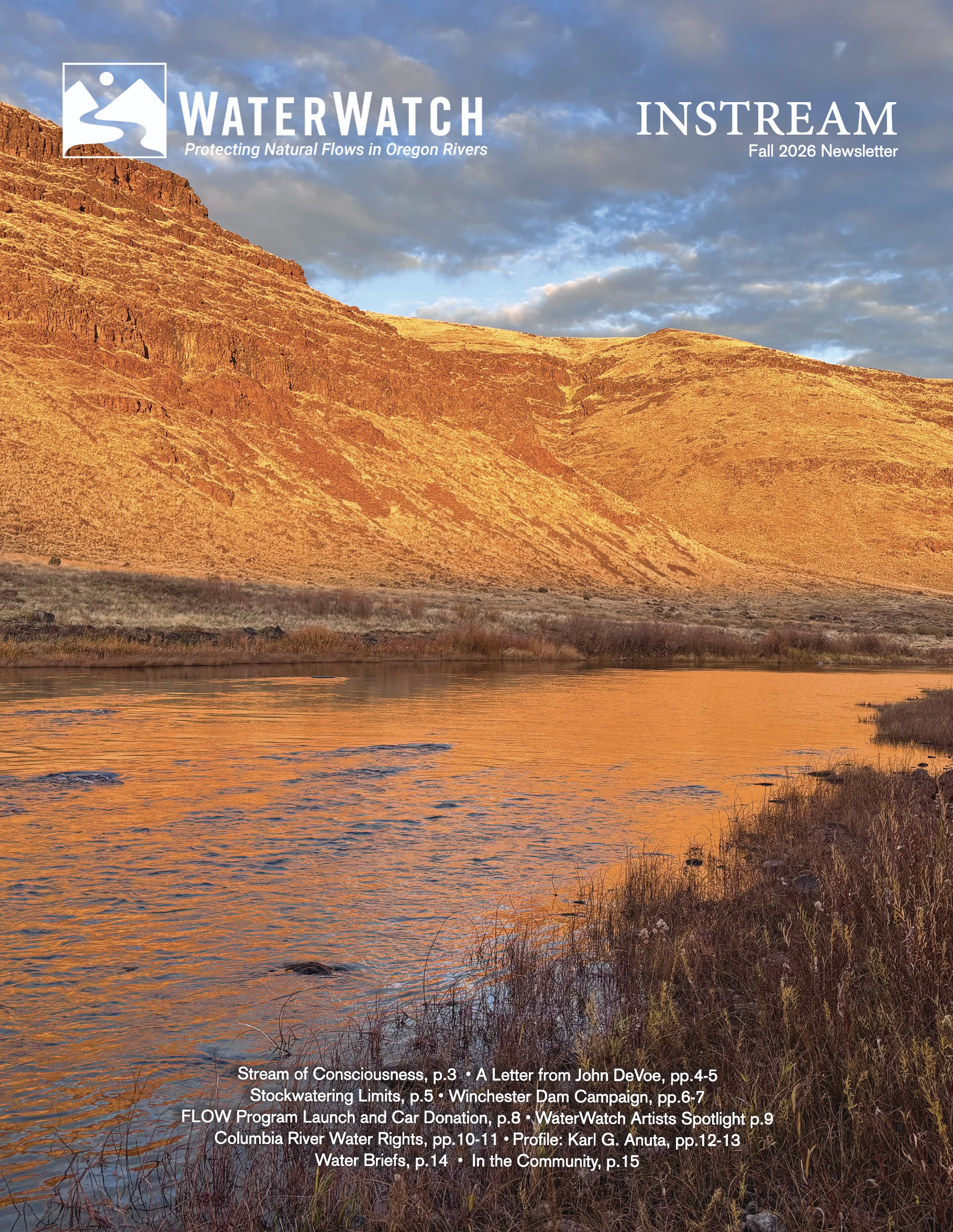
 This article appears in the fall 2026 issue of WaterWatch of Oregon’s Instream newsletter. Before he joined the WaterWatch of Oregon board of directors in 1989, attorney Karl G. Anuta was part of the early conversations with WaterWatch founders Tom and Audrey Simmons and Bob Hunter shortly after the establishment of the organization in 1985. One of the state’s leading experts on water law, Karl G. Anuta — married to former WaterWatch senior staff attorney and water policy advocate Karen Russell for 34 years — continues to support and do pro bono work for WaterWatch of Oregon, particularly as part of the ongoing fight against the construction of Thornburgh Resort on the Cline Buttes north of Bend. “I’ve always been a water-oriented person,” said Karl. “I grew up in Boulder fishing streams around Colorado, skiing in the winter, going out on lakes and swimming during the summer. So when I arrived in Portland to attend Lewis and Clark, I saw how green the Willamette Valley is during the winter. That was unusual for me, because unless it snowed everything is brown in Colorado during the winter. The water here is something I loved immediately, and still do. When it’s raining I’m just happy as I know it’s drawing salmon and steelhead upstream.” “After my undergraduate at Lewis and Clark, and a few years working as an armed security guard, I ended up going to law school at Lewis and Clark as well. That’s where I discovered water law,” said Karl. “I found it fascinating. Later, I was working at a firm where Larry Sokol, one of the partners, practiced environmental law as well as personal injury. Larry was an environmental litigation adjunct professor at Lewis and Clark and had hired me as a law clerk. One day he pulled me into his office and said, ‘Hey, you have to meet with these people, they want to meet with me and talk about water.’ It was Tom and Audrey Simmons. They were running some ideas by us about water law. I enjoyed meeting them, and started getting invited to their house for strategy sessions with Bob Hunter and a bunch of other folks.” Even as WaterWatch got off the ground in 1985, its founders were already developing what became Oregon’s landmark Instream Waters Rights Act, which was passed and signed into law in 1987 — one of the organization’s earliest and lasting successes. But Karl notes there were other big wins and cases in WaterWatch’s early years which the organization also played a lead role in. “Early on, Tom and Audrey took an interest in what’s called water spreading. That’s where irrigation districts become more efficient, but spread water onto lands outside of their actual permits,” said Karl. “They can grow more stuff, but it’s not legal to do it that way. WaterWatch challenged that illegal water spreading process by raising the facts before decision makers and the Oregon Water Resources Commission in ways they couldn’t ignore. That was a huge success, and it altered how water was used in the Umatilla Basin and elsewhere in Oregon.” “The Diack case also got a lot of press. Arch Diack owned several acres along the Sandy River. The city of Portland was going to divert a bunch of flow above the State Scenic Waterway section. WaterWatch fought that with Bill Hutchinson as the lead lawyer. Bill took it all the way to the Oregon Supreme Court and got a ruling that required the state to pay attention to downstream designations.” “Bill was a great trial lawyer who was doing pro bono work for WaterWatch and Arch Diack,” said Karl. “He showed up at the Supreme Court where the whole argument was supposed to be about this technical water law issue, and Bill said, look, a state scenic waterway without the water is meaningless. He pulled out a big poster he had made of the Mona Lisa with the smile removed, and said a state scenic waterway with no flow is just like the Mona Lisa with no smile. It’s not the same thing. Great trial theater. Totally made his technical point in a very understandable way. He did a great job and won the case.” Karl is known among the WaterWatch team for his consistency and determination in keeping an eye on the state’s public notices. He noted how WaterWatch’s advocacy has slowly begun to change long-held attitudes of state agencies like the Oregon Water Resources Department (OWRD), and how WaterWatch which played a major role in the agency’s re-evaluation of groundwater availability. “I was part of the WaterWatch team that saw this in the notices, leading to WaterWatch’s challenges to OWRD on groundwater,” he said. “Ultimately, that’s what caused the agency to suddenly step back and acknowledge there was a problem. Those challenges, coupled with the previously ignored data, have now fundamentally shifted the default answer on groundwater from yes, you can have it, to no, unless there’s capacity you can’t have it. That’s a huge step. After the Oregon Water Resources Commission adopted the amended groundwater allocation rules in 2024, one of the first articles I saw about it called it a ‘sea change’ in the regulations. That’s totally true. That shift in attitude was enormous, and it wouldn’t have occurred were it not for WaterWatch.” “WaterWatch plays a key role is keeping the agency’s feet to the fire on following actual management requirements, and also preventing them from doing stupid stuff,” said Karl. “In addition there are WaterWatch’s efforts at fighting off bad legislation proposals. Kimberley is a master of that.” Karl pointed out WaterWatch was one of the groups that stopped what he and Karen referred to as the ‘Flat Earth Bill’ in the 90s. “There was legislation put forward in the Oregon legislature that declared, as a matter of law, that groundwater and surface water were not connected. Never mind science and the concept of hydrology. That bill never made it out of committee, thanks to WaterWatch.” When it comes to Karl’s work to prevent construction of the Thornburgh Resort, he acknowledged it’s a huge issue. “It’s a destination resort that never should have been approved,” he said. “From a water standpoint, it’s just insane. It doesn’t have a functional water right and it’s going to be pumping groundwater in an area where the groundwater table, which is what they would exist on, is dramatically dropping. Bad idea. There was the limited license that Thornburgh tried to get that I litigated for WaterWatch. Thornburgh challenged the state’s conclusion that, from a geologic and hydrologic perspective, the Deschutes aquifer didn’t have any further capacity. Then Thornburgh challenged that. WaterWatch stepped in to help back up the state and help them prove that, no, that’s the situation in the Deschutes Basin.” “WaterWatch had protested the original Thornburgh permit back in the 90s. We were able to get a negotiated resolution where the resort cut its water use drastically. Then OWRD issued a permit, but sat on it for decades. That’s one of the permits we’re participating on now. Thornburgh never drilled a well, so no ‘extension’ is allowed. OWRD, to their credit, has now proposed to not only deny the extension, but to cancel that permit altogether.” WaterWatch is also supporting the state’s proposed denial of a new water right. “The Thornburgh folks don’t have any other water permits that would allow the functioning of yet another trophy home golf course resort in the Oregon high desert,” said Karl. “I personally think they know it’s a lost cause, and they are just trying to salvage something they can sell to some unwitting foreign buyers, but that’s just my own opinion.” Karl’s advice to upcoming Oregon leaders? “Pay attention to what the water use of everything is. If people are trying to build stuff, whether it’s low income housing or data centers, you need to figure out what the water use is, where that water is going to come from, and is it sustainable? You need to think about changing the water use and changing the way we handle water so you’re actually protecting and preserving it for future Oregonians, rather than just allocating it out. It’s not easy to do. Politically, it’s quite difficult. Legally you have to change some of the systems, and ultimately that’s what we really need to do.” Banner photo courtesy of Karl G. Anuta, John Day River Instream cover photo couresy of Andy Archer, Instream cover design by Monet Hampson.
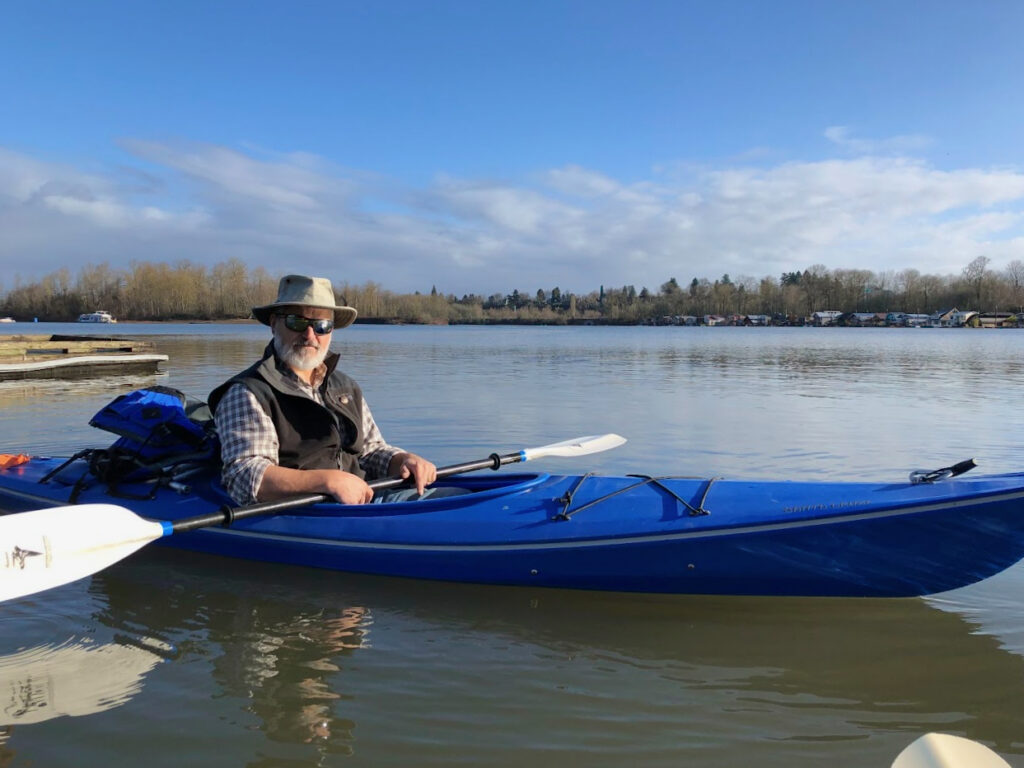
Instream: Connecting with Board Member Karl G. Anuta on WaterWatch’s Many Roles
This article appears in the fall 2026 issue of WaterWatch of Oregon’s Instream newsletter. Before he joined the WaterWatch of Oregon board of directors in 1989, attorney Karl G. Anuta was part of the early conversations with WaterWatch founders Tom and Audrey Simmons and Bob Hunter shortly after the establishment of the organization in 1985. One of the state’s leading experts on water law, Karl G. Anuta — married to former WaterWatch senior staff attorney and water policy advocate Karen Russell for 34 years — continues to support and do pro bono work for WaterWatch of Oregon, particularly as part of the ongoing fight against the construction of Thornburgh Resort on the Cline Buttes north of Bend. “I’ve always been a water-oriented person,” said Karl. “I grew up in Boulder fishing streams around Colorado, skiing in the winter, going out on lakes and swimming during the summer. So when I arrived in Portland to attend Lewis and Clark, I saw how green the Willamette Valley is during the winter. That was unusual for me, because unless it snowed everything is brown in Colorado during the winter. The water here is something I loved immediately, and still do. When it’s raining I’m just happy as I know it’s drawing salmon and steelhead upstream.” “After my undergraduate at Lewis and Clark, and a few years working as an armed security guard, I ended up going to law school at Lewis and Clark as well. That’s where I discovered water law,” said Karl. “I found it fascinating. Later, I was working at a firm where Larry Sokol, one of the partners, practiced environmental law as well as personal injury. Larry was an environmental litigation adjunct professor at Lewis and Clark and had hired me as a law clerk. One day he pulled me into his office and said, ‘Hey, you have to meet with these people, they want to meet with me and talk about water.’ It was Tom and Audrey Simmons. They were running some ideas by us about water law. I enjoyed meeting them, and started getting invited to their house for strategy sessions with Bob Hunter and a bunch of other folks.” Even as WaterWatch got off the ground in 1985, its founders were already developing what became Oregon’s landmark Instream Waters Rights Act, which was passed and signed into law in 1987 — one of the organization’s earliest and lasting successes. But Karl notes there were other big wins and cases in WaterWatch’s early years which the organization also played a lead role in. “Early on, Tom and Audrey took an interest in what’s called water spreading. That’s where irrigation districts become more efficient, but spread water onto lands outside of their actual permits,” said Karl. “They can grow more stuff, but it’s not legal to do it that way. WaterWatch challenged that illegal water spreading process by raising the facts before decision makers and the Oregon Water Resources Commission in ways they couldn’t ignore. That was a huge success, and it altered how water was used in the Umatilla Basin and elsewhere in Oregon.” “The Diack case also got a lot of press. Arch Diack owned several acres along the Sandy River. The city of Portland was going to divert a bunch of flow above the State Scenic Waterway section. WaterWatch fought that with Bill Hutchinson as the lead lawyer. Bill took it all the way to the Oregon Supreme Court and got a ruling that required the state to pay attention to downstream designations.” “Bill was a great trial lawyer who was doing pro bono work for WaterWatch and Arch Diack,” said Karl. “He showed up at the Supreme Court where the whole argument was supposed to be about this technical water law issue, and Bill said, look, a state scenic waterway without the water is meaningless. He pulled out a big poster he had made of the Mona Lisa with the smile removed, and said a state scenic waterway with no flow is just like the Mona Lisa with no smile. It’s not the same thing. Great trial theater. Totally made his technical point in a very understandable way. He did a great job and won the case.” Karl is known among the WaterWatch team for his consistency and determination in keeping an eye on the state’s public notices. He noted how WaterWatch’s advocacy has slowly begun to change long-held attitudes of state agencies like the Oregon Water Resources Department (OWRD), and how WaterWatch which played a major role in the agency’s re-evaluation of groundwater availability. “I was part of the WaterWatch team that saw this in the notices, leading to WaterWatch’s challenges to OWRD on groundwater,” he said. “Ultimately, that’s what caused the agency to suddenly step back and acknowledge there was a problem. Those challenges, coupled with the previously ignored data, have now fundamentally shifted the default answer on groundwater from yes, you can have it, to no, unless there’s capacity you can’t have it. That’s a huge step. After the Oregon Water Resources Commission adopted the amended groundwater allocation rules in 2024, one of the first articles I saw about it called it a ‘sea change’ in the regulations. That’s totally true. That shift in attitude was enormous, and it wouldn’t have occurred were it not for WaterWatch.” “WaterWatch plays a key role is keeping the agency’s feet to the fire on following actual management requirements, and also preventing them from doing stupid stuff,” said Karl. “In addition there are WaterWatch’s efforts at fighting off bad legislation proposals. Kimberley is a master of that.” Karl pointed out WaterWatch was one of the groups that stopped what he and Karen referred to as the ‘Flat Earth Bill’ in the 90s. “There was legislation put forward in the Oregon legislature that declared, as a matter of law, that groundwater and surface water were not connected. Never mind science and the concept of hydrology. That bill never made it out of committee, thanks to WaterWatch.” When it comes to Karl’s work to prevent construction of the Thornburgh Resort, he acknowledged it’s a huge issue. “It’s a destination resort that never should have been approved,” he said. “From a water standpoint, it’s just insane. It doesn’t have a functional water right and it’s going to be pumping groundwater in an area where the groundwater table, which is what they would exist on, is dramatically dropping. Bad idea. There was the limited license that Thornburgh tried to get that I litigated for WaterWatch. Thornburgh challenged the state’s conclusion that, from a geologic and hydrologic perspective, the Deschutes aquifer didn’t have any further capacity. Then Thornburgh challenged that. WaterWatch stepped in to help back up the state and help them prove that, no, that’s the situation in the Deschutes Basin.” “WaterWatch had protested the original Thornburgh permit back in the 90s. We were able to get a negotiated resolution where the resort cut its water use drastically. Then OWRD issued a permit, but sat on it for decades. That’s one of the permits we’re participating on now. Thornburgh never drilled a well, so no ‘extension’ is allowed. OWRD, to their credit, has now proposed to not only deny the extension, but to cancel that permit altogether.” WaterWatch is also supporting the state’s proposed denial of a new water right. “The Thornburgh folks don’t have any other water permits that would allow the functioning of yet another trophy home golf course resort in the Oregon high desert,” said Karl. “I personally think they know it’s a lost cause, and they are just trying to salvage something they can sell to some unwitting foreign buyers, but that’s just my own opinion.” Karl’s advice to upcoming Oregon leaders? “Pay attention to what the water use of everything is. If people are trying to build stuff, whether it’s low income housing or data centers, you need to figure out what the water use is, where that water is going to come from, and is it sustainable? You need to think about changing the water use and changing the way we handle water so you’re actually protecting and preserving it for future Oregonians, rather than just allocating it out. It’s not easy to do. Politically, it’s quite difficult. Legally you have to change some of the systems, and ultimately that’s what we really need to do.” Banner photo courtesy of Karl G. Anuta, John Day River Instream cover photo couresy of Andy Archer, Instream cover design by Monet Hampson.