
This article appears in the fall 2026 issue of WaterWatch of Oregon’s Instream newsletter.
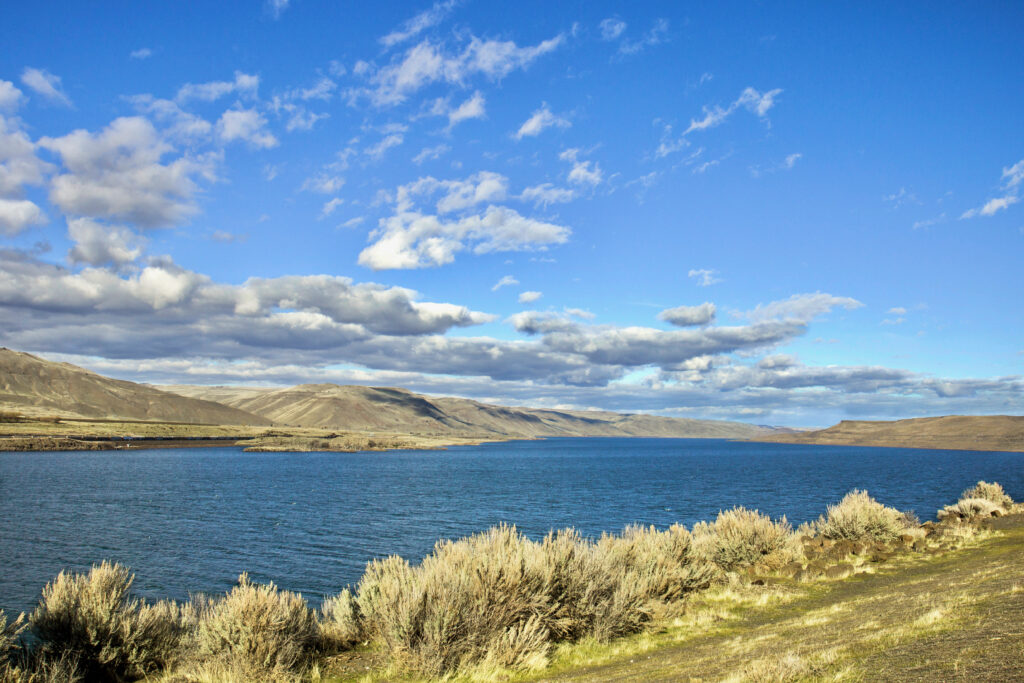
Emerging from the Canadian Rockies in British Columbia, the Columbia River runs 1,214 miles through seven states on its journey to the Pacific Ocean. Once an ecological powerhouse home to 27 wild salmon and steelhead stocks, the river has been drastically altered to support navigation, hydropower, flood control, and agriculture. Human engineering has blocked migration, altered natural flow regimes, warmed waters, and transformed this once magnificent “living” river into a series of warm, slow-moving reservoirs that have devastated fish and wildlife populations, tribal cultures, and river related economies.
The impact on Northwest salmon and steelhead has been particularly devastating. Of the 16 stocks that historically spawned above Bonneville Dam, four are now extinct and seven are listed under the federal Endangered Species Act and dangerously close to extinction.
While there have been a variety of efforts to restore and protect Columbia River Basin salmon over the decades, WaterWatch has focused much of its work on state water right angles. In particular, we have advanced streamflow protections in the Umatilla Basin via legal challenges, collaborative agreements, and state rulemakings tied to water right permitting. Key agreements and/or initiatives over the past 40 years include:
- Umatilla Basin Exchange Project Water Rights Settlement:
Authorized by Congress in 1988, the Umatilla Water Exchange Project trades water from the Umatilla River for water in the Columbia to help Umatilla River salmon and steelhead while keeping farms supplied with water for irrigation. In the early 1990s, WaterWatch acted as a legal watchdog and crucial negotiator in the Umatilla Basin Exchange Project water right proceedings. As a result of the legal settlement reached, there are now legally protected instream flow rights for salmon in the Umatilla, which guarantees the water saved by the Exchange Project remains in the Umatilla River channel during critical migration periods. By the mid-1990s fish had returned to the river for the first time in 70 years. - Halting Water Spreading in the Umatilla Basin:
Intertwined with our work on the Umatilla Basin Exchange Project Water Right Settlement, WaterWatch published a groundbreaking report in 1991 detailing rampant illegal use of water beyond irrigation district boundaries, otherwise known as “water spreading.” This ultimately resulted in federal and state efforts to crack down on this longstanding problem, which included restricting the land base that could receive water under the Umatilla Basin Exchange Water Rights Settlement. - Sensitive Stock Rules for Columbia River Salmon and Steelhead Adopted:
In 1994, WaterWatch petitioned the state to close the Columbia River to further appropriations in response to the listing of salmon and steelhead under the federal Endangered Species Act. While the petition failed by one vote, in response the Oregon Water Resources Commission adopted the “sensitive stock” rules in 1996 that, among other things, prohibited the issuance of new water rights that allow withdrawals from the Columbia River and its tributaries from April through October to protect flows for imperiled salmon and steelhead. - Landmark Boeing Water Right Settlement Cuts Water Use and Protects Habitat:
In 1995, WaterWatch challenged the state’s approval of an extension of time that would have allowed a large farming operation to develop massive water rights from the Columbia on what were known as the “Boeing Lands.” This challenge, combined with our work on a Clean Water Act case and the listing of the Washington Ground Squirrel, culminated in a 2001 Settlement Agreement that reduced water rights by over 1,000 cubic feet per second (cfs), protected over 22,000 acres of shrub steppe habitat, and restricted the land base where water could be used. This work also led the state to revamp its rules governing extensions of time to develop water right permits to better protect fish. - Columbia River-Umatilla Solutions Taskforce:
Starting in the 1997 legislative session, Umatilla irrigators put their sights on undermining protections the state had put in place to protect salmon. From 2007 to 2012, eight bills were brought that would have provided carve out from fish protection rules for Umatilla Basin irrigators. All of them failed. In an attempt to stave off future bad bills targeting the Columbia, Governor Kitzhaber convened the Columbia River-Umatilla Solutions Task Force (CRUST), which was made up of the Governor’s office, state agency directors, the Confederated Tribes of the Umatilla Indian Reservation, a Umatilla County commissioner, conservation groups (including WaterWatch), federal agencies, and Umatilla Irrigation interests. In 2013, after eight months of negotiations, a high-level framework was signed to investigate a few select pathways to support irrigation in a way that would not undermine existing fish protection laws or harm flows. - “Mitigated” Water Rights Approved:
As a follow up to CRUST, the Governor’s office, state water management and fisheries agencies, OWRD, ODFW, WaterWatch, and the Northeast Oregon Water Association (NOWA), entered into more than two years of intense negotiations over new water right applications. In 2017, the group reached a negotiated agreement on eight new water rights for 180 cfs; these were heavily negotiated down to the word. Among other things, these rights required bucket-for-bucket mitigation at or above the point of impact for the 180 cfs to meet the Sensitive Stock Rule directives. The issuance of the new “mitigated” water rights signaled a new era of water management in the basin in which irrigators agreed to meet fish protection measures rather than fight them.
The collaborative spirit reached in the CRUST Declaration of Cooperation and ensuing water rights agreement was, unfortunately, short lived. Soon after the state issued the eight water rights, the holders of the “mitigated water rights” applied for new water rights to supersede the existing negotiated rights. The new applications sought to expand the existing water right footprint roughly sixfold from 123,442 acres to 702,227 acres, add additional diversion points, and alter nearly all the negotiated conditions that were agreed to in the 2017 agreement. Additionally, in a related but separate campaign, permit holders are also seeking to push the state to move to “volumetric mitigation,” rather than real time mitigation, in violation of permit conditions, the sensitive stock rules, and the negotiated agreements.
Continuing their efforts to both skirt their negotiated water right agreements and undermine the long standing legal settlements and collaborative agreements reached over the past 40 years, NOWA brought HB 4006 in the 2026 legislative session that would have exempted Umatilla Basin irrigators who divert surface water on a 51-mile stretch of the Columbia River from important transfer laws that every other farmer in Oregon must abide by. The bill would have allowed a significant increase in water volume pulled from the Columbia with no regard of the impact on imperiled salmon, increased irrigated agriculture over a 700,000 acre footprint (roughly the size of Rhode Island), legalized water spreading, kneecapped the state’s ability to manage water rights beyond the diversion points on the Columbia, risked greater nitrate contamination to the area’s groundwater, and declared inter-governmental entities “districts” statewide – giving them the ability to condemn both private and state lands among other concerns.
In attempting to pass HB 4006, NOWA sought to exempt Umatilla irrigators from the basic tenets of western water law, specific permit conditions, state oversight, and, as noted above, the very agreements that they (and/or their members) were party to over the past 40 years. While the bill did not pass into law, NOWA has vowed to bring it back in 2027 under a concept called “The Color of Water.”
Unfortunately, legislators voicing support for this measure do not appear to be doing their due diligence to understand the implications of this bill not only on salmon, tribes, and state water management but also the many important legal settlements and/or collaborative agreements that have shaped water management in the basin for the past 40 years.
With the current federal administration rolling back the keystone environmental laws that have been so pivotal to protecting Northwest salmon, Oregon’s legislators need to do more, not less, to protect our environment and the iconic species that call Oregon home.
What can you do to help? As we prepare to move into the 2027 session, please call your legislators today and ask them to protect Columbia River salmon and steelhead and oppose “The Color of Water” bill.
Columbia River photo courtesy of Bonnie Moreland, John Day River Instream cover photo couresy of Andy Archer, Instream cover design by Monet Hampson.
 Get your edition of this framed Willamette River print, they won’t last long! Dan Coe prints are available by: